Active Learning (AL)
Overview
Active Learning module for building predictive and interpretable models
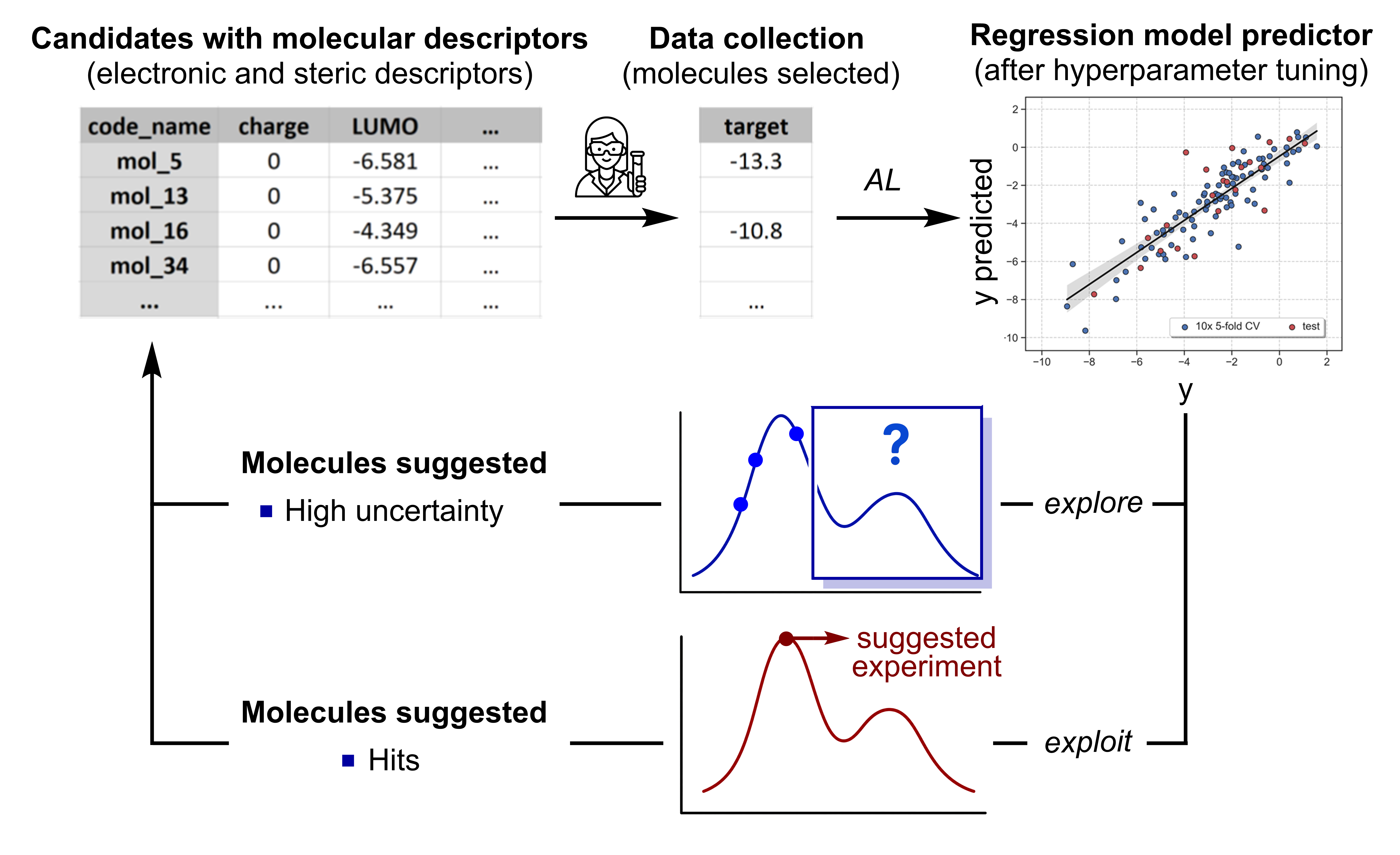
When the goal is to build a predictive and interpretable model, ALMOS incorporates an active learning strategy designed to improve model performance through informed data acquisition. The current implementation uses ROBERT to train and evaluate the predictive model at each iteration, then ranks unlabeled points according to the selected active learning strategy.
The AL module supports three practical operating modes:
Auto mode: ALMOS decides whether the next batch should prioritize model improvement or hit-seeking based on the current ROBERT model score.
Model mode: ALMOS ranks unlabeled candidates only by predictive uncertainty and selects the highest-uncertainty points.
Hit mode: ALMOS ranks candidates using a confidence-bound acquisition function. For maximization it uses an upper confidence bound (UCB), and for minimization it uses a lower confidence bound (LCB).
How AL works
The AL workflow is currently:
Retrain the model with the currently labeled rows.
Generate predictions and predictive uncertainty for the unlabeled rows.
Choose a strategy:
in
auto, from the ROBERT score;in
--mode model, by pure uncertainty;in
--mode hit, byobjectiveand optionalalpha.
Select the next batch of size
--n_exps.Write the new batch CSV and log convergence / model-quality information.
The AL module requires a curated CSV file containing:
Molecular descriptors (numerical input features).
A target property column.
A batch column indicating which datapoints are already labeled (for example,
batch = 0from CLUSTER and later experimental rounds).
Example usage:
al --csv_name EXAMPLE.csv --y Y_VALUE --name code_name --n_exps 10
al --csv_name EXAMPLE.csv --y Y_VALUE --name code_name --n_exps 10 --mode model
al --csv_name EXAMPLE.csv --y Y_VALUE --name code_name --n_exps 10 --mode hit --objective max --alpha 0.5
Main parameters
The most commonly used options in the current AL workflow are:
--csv_name: input CSV for the active learning cycle.--name: identifier column used to report which candidates are selected.--y: target property to model.--n_exps: number of unlabeled candidates suggested for the next batch.--ignore: columns that should not be used as descriptors. Typical examples arebatch, identifiers or textual metadata columns.--mode: active learning mode. The available user-facing choices are:auto: ALMOS decides the strategy from the current ROBERT score.model: select candidates only by predictive uncertainty.hit: select candidates using a confidence-bound acquisition function.
--objective: only used inhitmode.max: ranks candidates using an upper confidence bound (UCB), suitable when the goal is to maximize the target.min: ranks candidates using a lower confidence bound (LCB), suitable when the goal is to minimize the target.
--alpha: only used inhitmode. This controls the weight of predictive uncertainty in the acquisition score. Larger values place more emphasis on exploration, while smaller values favor exploitation of the predicted optimum.
Typical command-line patterns:
al --csv_name EXAMPLE.csv --y Y_VALUE --name code_name --n_exps 10
al --csv_name EXAMPLE.csv --y Y_VALUE --name code_name --n_exps 10 --mode model
al --csv_name EXAMPLE.csv --y Y_VALUE --name code_name --n_exps 10 --mode hit --objective max
al --csv_name EXAMPLE.csv --y Y_VALUE --name code_name --n_exps 10 --mode hit --objective min --alpha 0.5
AL Protocol in ALMOS
The user supplies a CSV file with molecular descriptors, a target column and at least one labeled batch.
ALMOS retrains a ROBERT model on the labeled rows.
The model predicts values and uncertainty for all unlabeled datapoints.
ALMOS resolves the active learning strategy:
autobased on model score,modelfor uncertainty-only selection,hitfor UCB / LCB ranking.
The selected datapoints become the next suggested experimental batch.
Important options
--mode model: force model-improvement selection by highest uncertainty--mode hit: force hit-seeking selection--objective max: use UCB-style ranking--objective min: use LCB-style ranking--alpha: confidence-bound weight used only in hit mode--n_exps: number of points suggested for the next batch
Reference
ROBERT: https://github.com/jvalegre/robert (Wiley Interdisciplinary Reviews: Computational Molecular Science 2024, 14, e1733.) Dalmau, D.; Alegre Requena, J. V. ROBERT: Bridging the Gap between Machine Learning and Chemistry.
Example
An example is available in Examples/Use of individual modules.